- 28 December 2025
- in WordPress Plugins
- by QuanticaLabs
- 112
- 0

Transport bookings look simple on the surface, but the business logic behind them rarely is. Airport transfers, hourly chauffeur services, point-to-point rides, tours, and fixed packages all follow different rules for pricing, availability, and validation.
This overview explains what makes the Chauffeur Taxi Booking System for WordPress different from typical “taxi plugins”: it is designed to handle multiple booking models in one consistent workflow, with pricing and availability rules flexible enough to match real-world operations.
If you want to evaluate whether this plugin fits your business, the sections below will help you understand the booking models it supports, how pricing can be configured, what integrations are available, and which use cases it is best suited for.
The Chauffeur Taxi Booking System for WordPress is not a generic taxi booking plugin and it is not designed to handle a single, simplified booking scenario. It is a transport booking system built for businesses that operate with multiple service types, pricing rules, and availability constraints — all within one consistent booking flow.
This plugin was created to reflect how real chauffeur, limo, and transport companies actually work. Airport transfers, hourly services, point-to-point rides, tours, and fixed packages often coexist in the same business, but each follows different pricing logic and validation rules. Most plugins solve only one of these cases. This system was designed to support all of them without forcing workarounds.
If your business needs nothing more than a basic distance × price calculation, this plugin is probably more than you need. But if you run a chauffeur, limo, or transport service where pricing depends on service type, time, distance, location rules, vehicle selection, or availability logic, this system was built for exactly that.
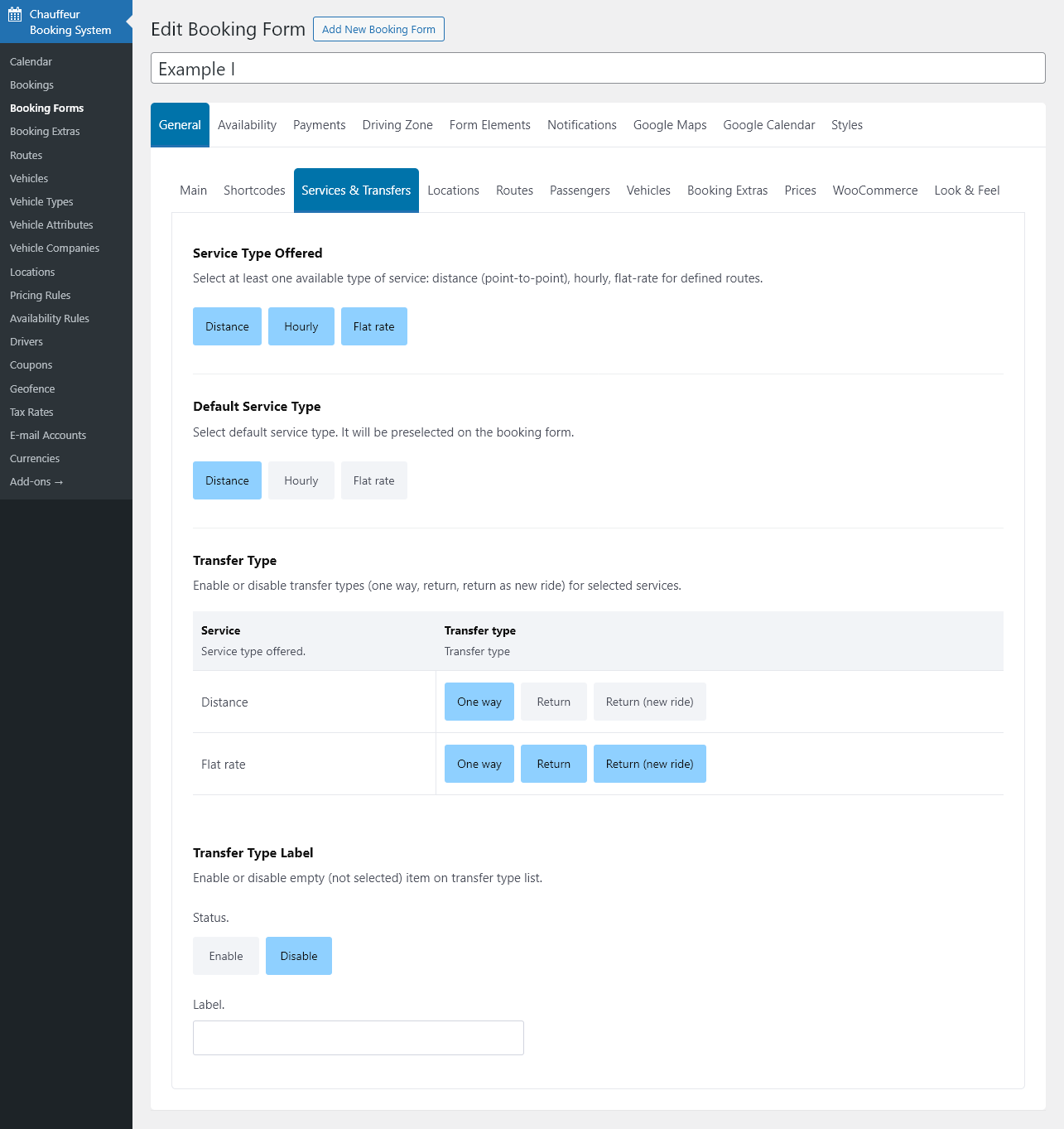
One of the main reasons transport businesses outgrow basic taxi plugins is that real-world services rarely fit into a single booking model. Airport transfers, hourly chauffeur services, fixed routes, and tours each require different validation rules, pricing logic, and availability checks. The Chauffeur Taxi Booking System was built to support these models within one unified booking flow.
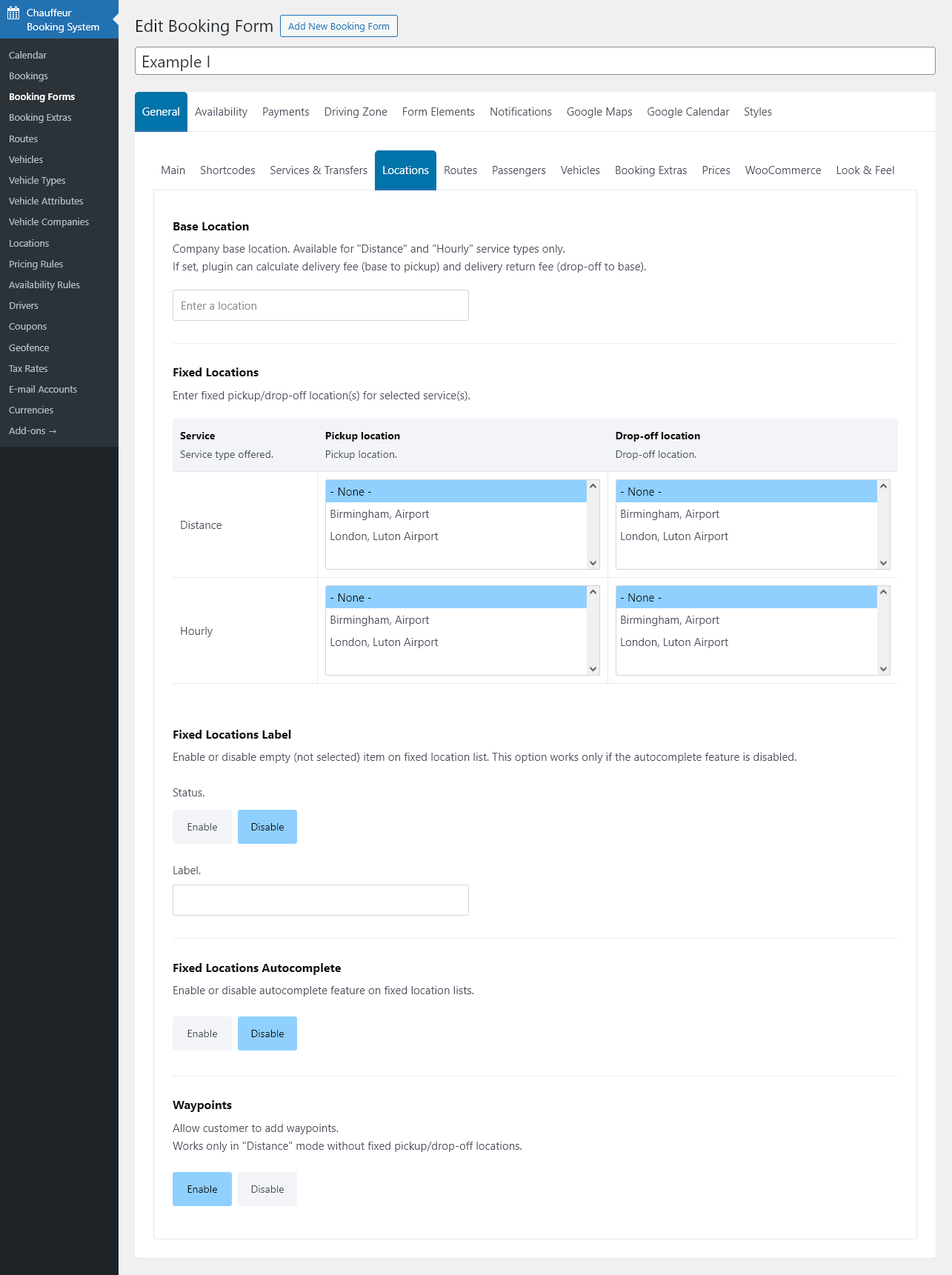
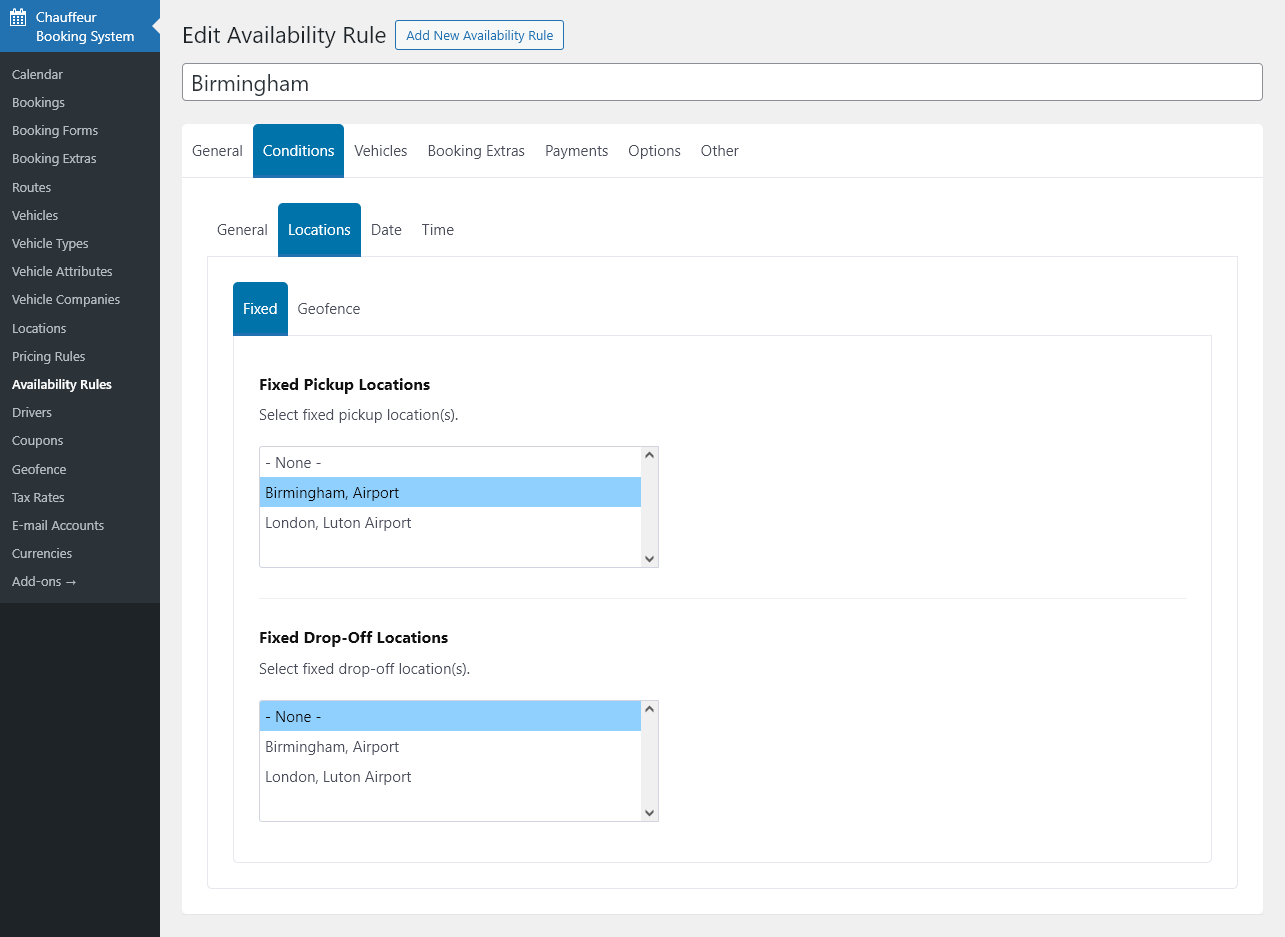
Airport transfers are the backbone of many chauffeur and limo businesses, but they are also one of the most demanding booking scenarios. Pricing often depends on predefined routes, zones, distance, vehicle type, time of day, or pickup and drop-off combinations. The system supports fixed airport routes as well as flexible location-based pricing, allowing businesses to define exactly how transfers should be calculated.
Advanced validation ensures that only valid pickup and drop-off combinations can be booked, preventing incorrect or unprofitable reservations before they reach the checkout stage.
Hourly bookings introduce a different set of challenges: minimum rental time, service time windows, vehicle availability, and additional fees for extra hours. This plugin allows businesses to define hourly services with precise control over duration rules, pricing increments, and availability constraints, without mixing them with distance-based logic.
This separation is critical for companies offering premium chauffeur services, where time-based pricing must remain predictable and easy to manage.
Point-to-point services combine elements of both distance and route validation. Customers select pickup and drop-off locations, while the system calculates pricing based on distance, zones, or predefined rules. Unlike basic fare calculators, pricing does not rely on a single formula but can adapt to business-specific logic such as service areas, excluded zones, or vehicle-based restrictions.
For tours, shuttles, and recurring routes, distance-based calculations are often unnecessary or even misleading. The plugin supports fixed-price routes and tour packages where pricing, duration, and availability are predefined. This makes it possible to sell structured transport services without forcing them into a distance-based model.
Fixed routes can coexist with other booking models in the same system, allowing businesses to expand their offer without adding new plugins or workflows.
By supporting multiple booking models in one system, the plugin eliminates the need for compromises, custom code, or parallel booking tools — a common limitation of simpler taxi plugins.
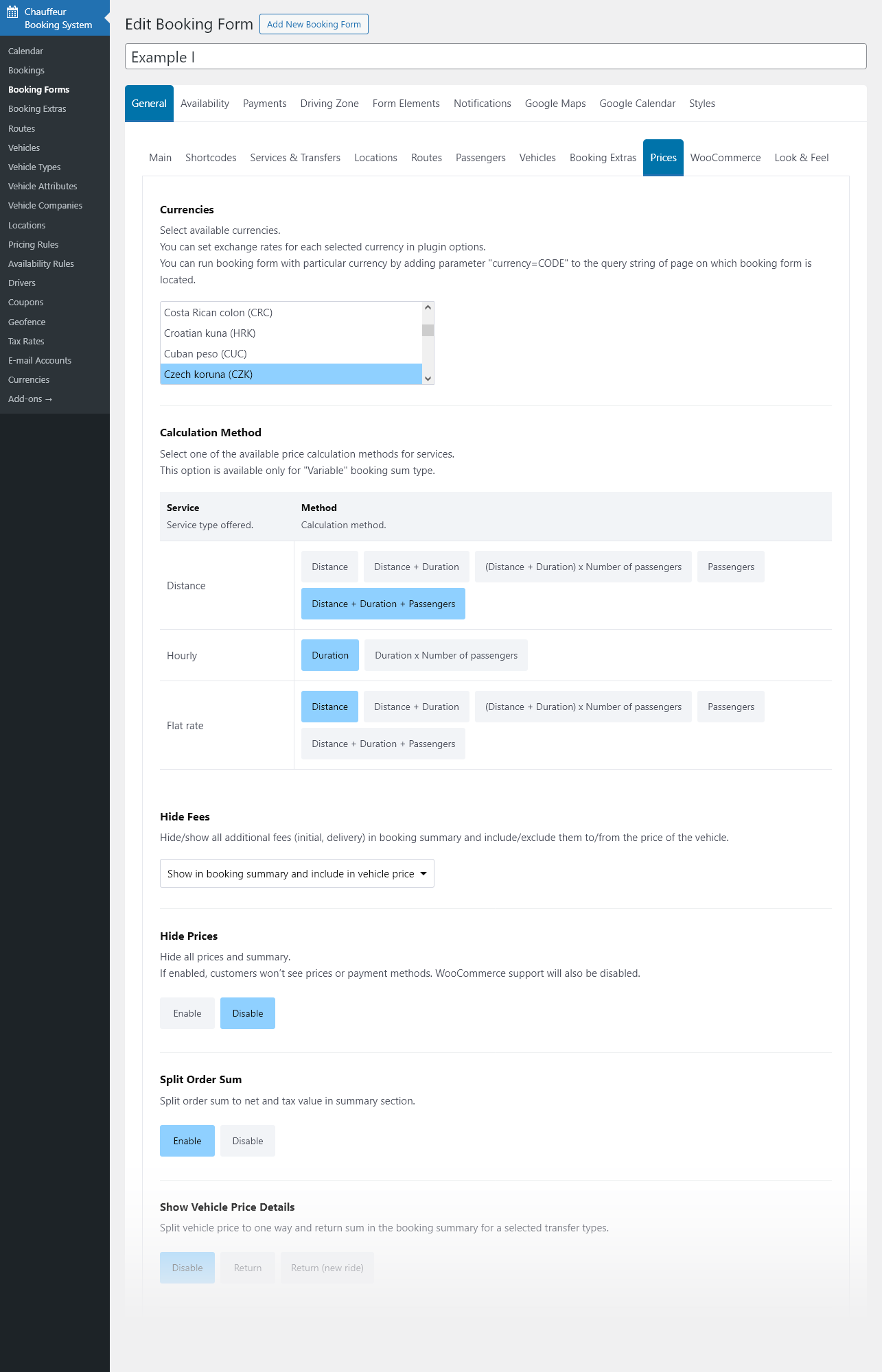
Pricing is where most taxi and transport plugins break down. Fixed rates, simple distance calculations, or single pricing formulas may work for basic use cases, but they fail as soon as a business introduces multiple service types, vehicles, locations, or operational constraints. The plugin approaches pricing as a flexible, rule-driven system rather than a single calculation.
Instead of forcing all services into one formula, pricing logic is applied based on conditions that reflect how transport businesses actually operate. Different booking models can follow completely different pricing strategies without interfering with each other.
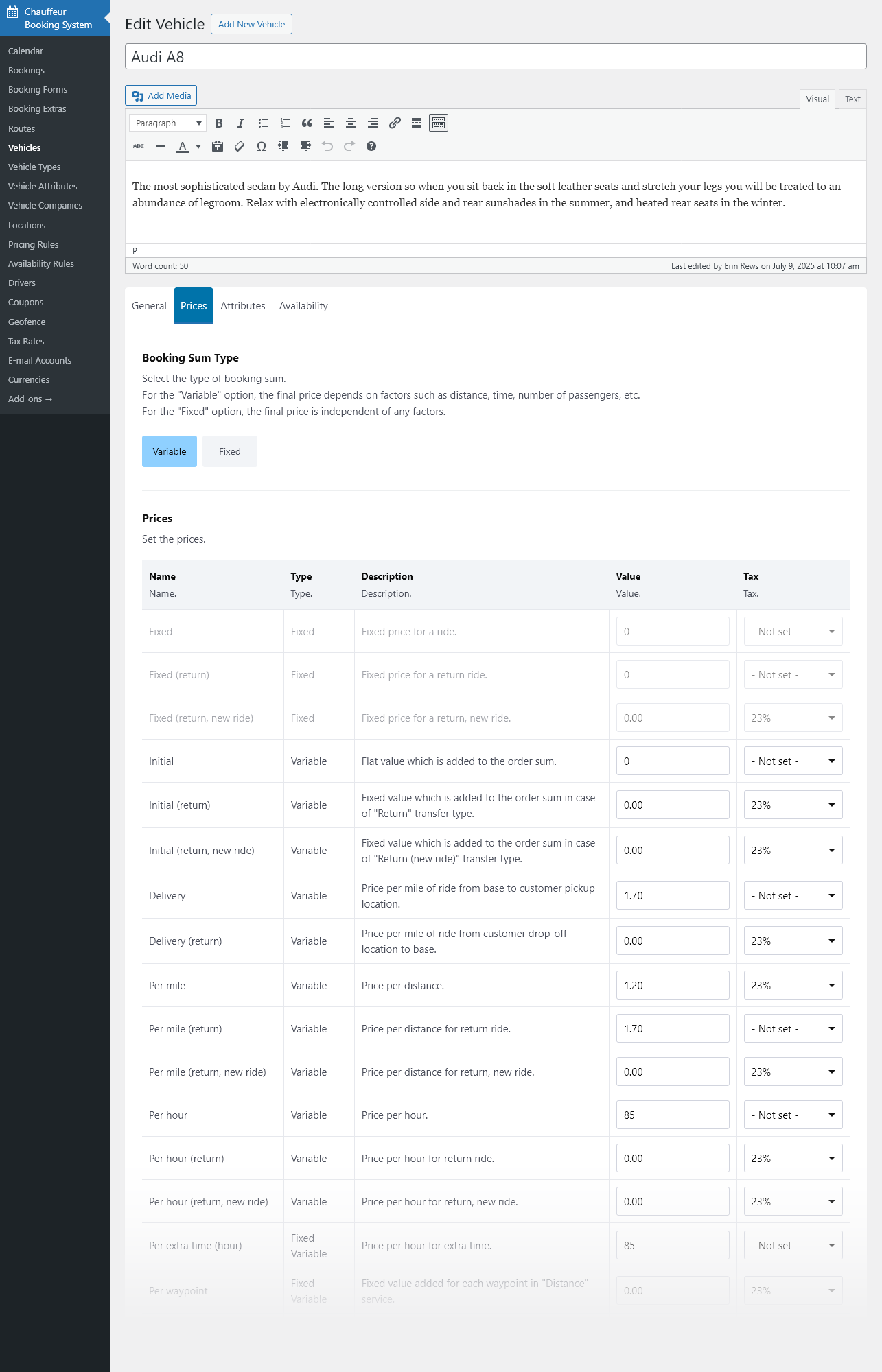
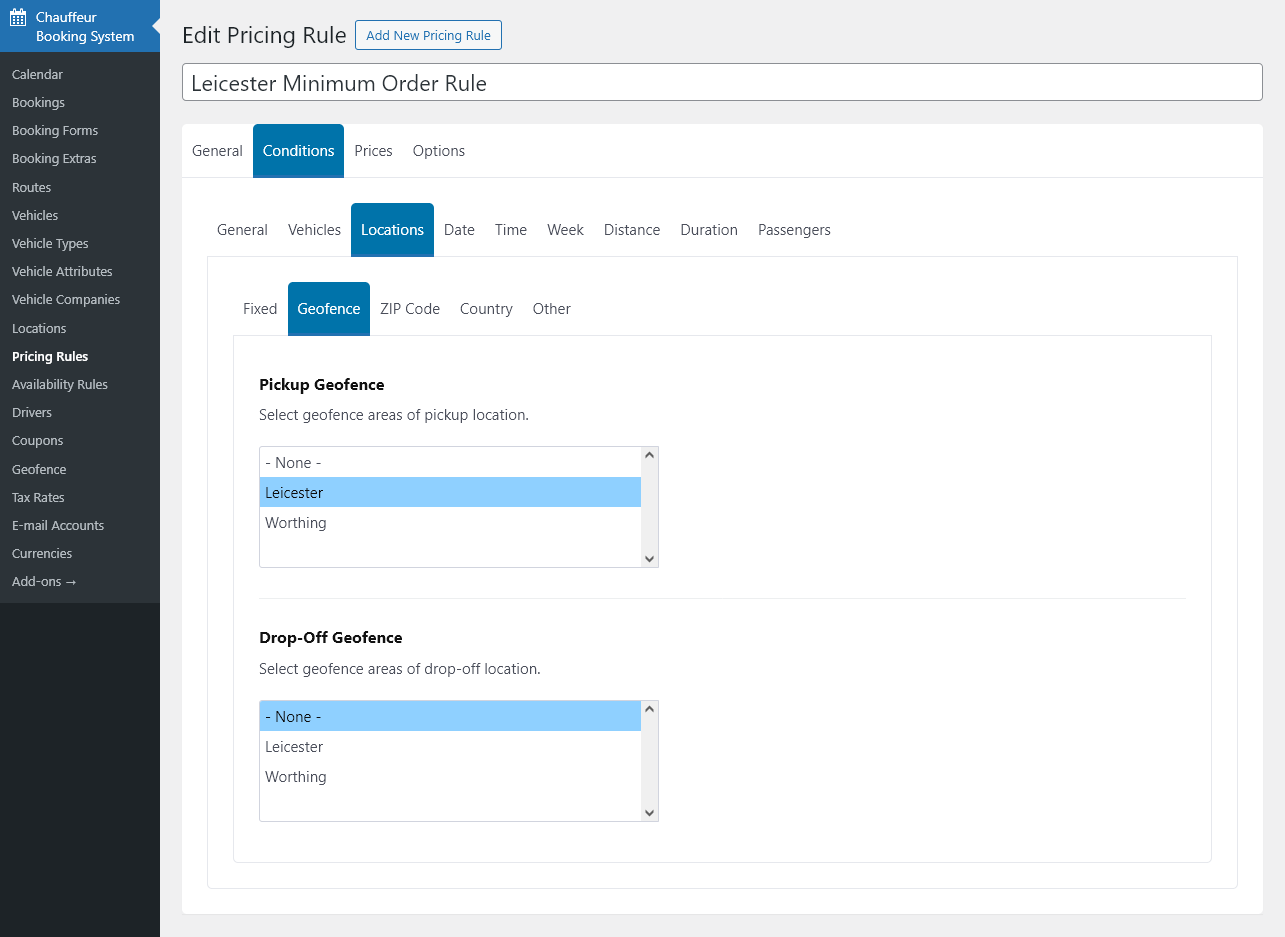
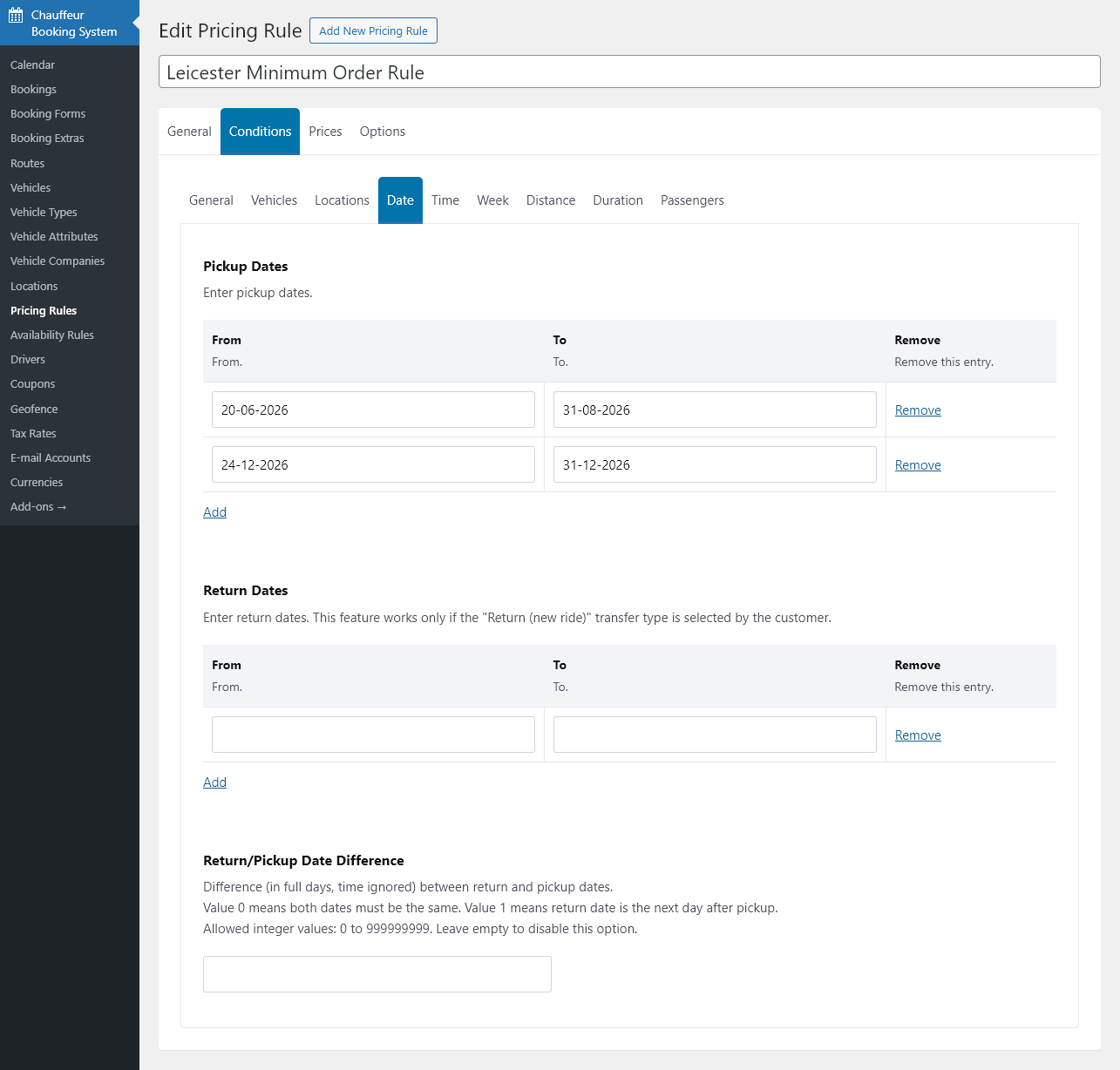
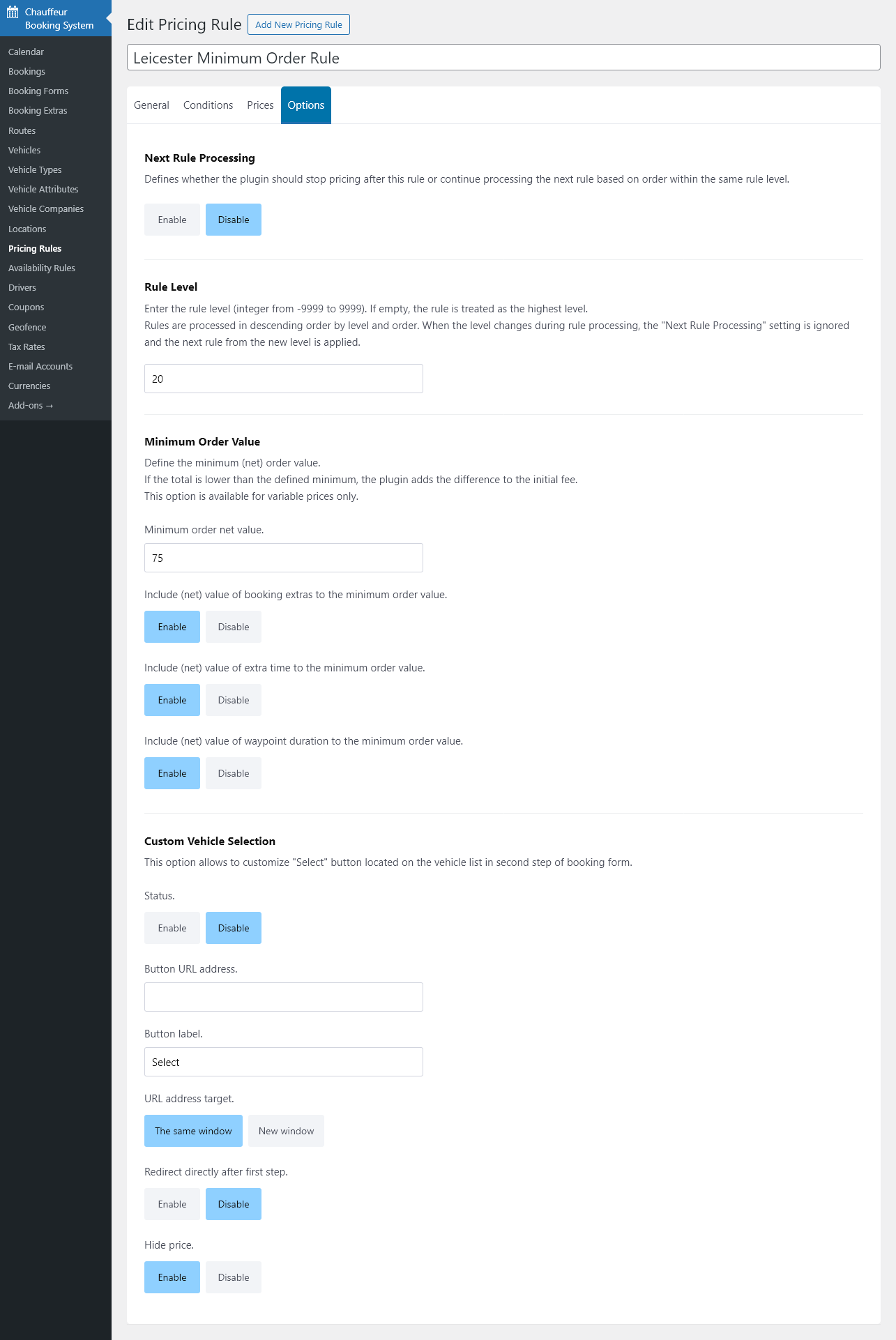
At the core of the system is a pricing engine built around rules rather than hardcoded assumptions. Pricing can respond dynamically to factors such as service type, route, distance, duration, location, vehicle selection, or time constraints. This makes it possible to model real-world pricing scenarios without rewriting logic or maintaining separate booking forms.
Crucially, pricing rules are evaluated in a controlled order, allowing businesses to layer logic instead of replacing it. This avoids the common limitation where one pricing condition overwrites another and leads to unpredictable results.
One of the most common mistakes in transport booking systems is mixing pricing logic with availability checks. In this system, pricing rules and availability rules are handled independently. This separation allows businesses to change how services are priced without accidentally affecting vehicle availability or booking validation.
As a result, complex scenarios such as restricted service areas, time-based availability, or vehicle-specific constraints can coexist with flexible pricing models in a predictable way.
Transport businesses rarely operate on flat pricing alone. Airport transfers, hourly chauffeur services, long-distance rides, and tours often require different pricing strategies within the same company. The system supports these scenarios by allowing pricing rules to adapt to each booking context rather than forcing a single approach.
This flexibility is especially important for growing businesses that need to adjust pricing over time without restructuring their entire booking setup.
By treating pricing as a layered, rule-based system, the Chauffeur Taxi Booking provides a level of control that simple taxi plugins cannot offer — without locking businesses into rigid formulas or external pricing engines.
Availability management is one of the most underestimated challenges in transport booking systems. Many plugins treat availability as a simple on/off switch, which quickly leads to conflicts, overbooking, or bookings that cannot be fulfilled operationally. The Chauffeur Booking System approaches availability as a structured part of the booking logic, tightly aligned with service types and business constraints.
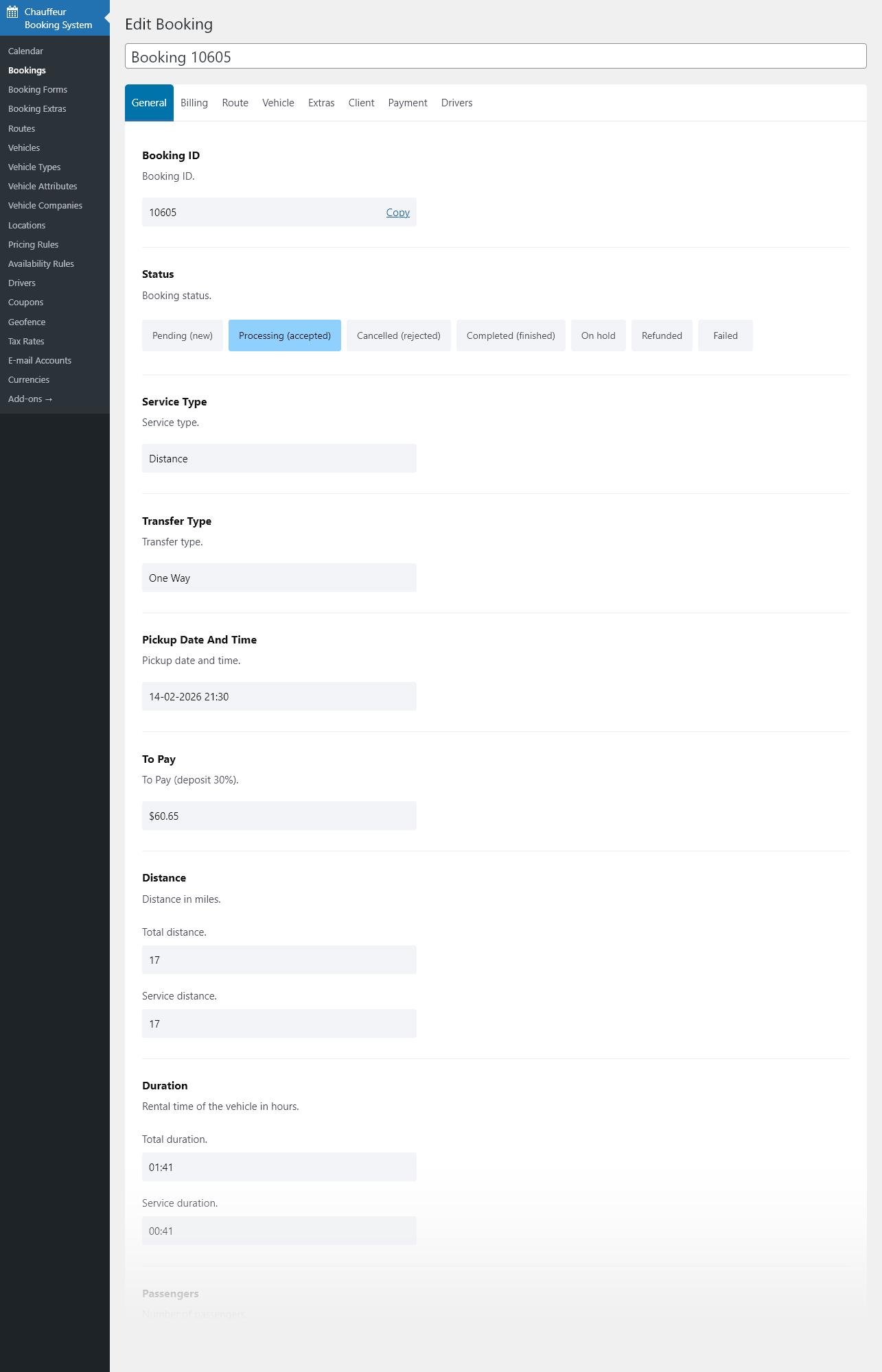
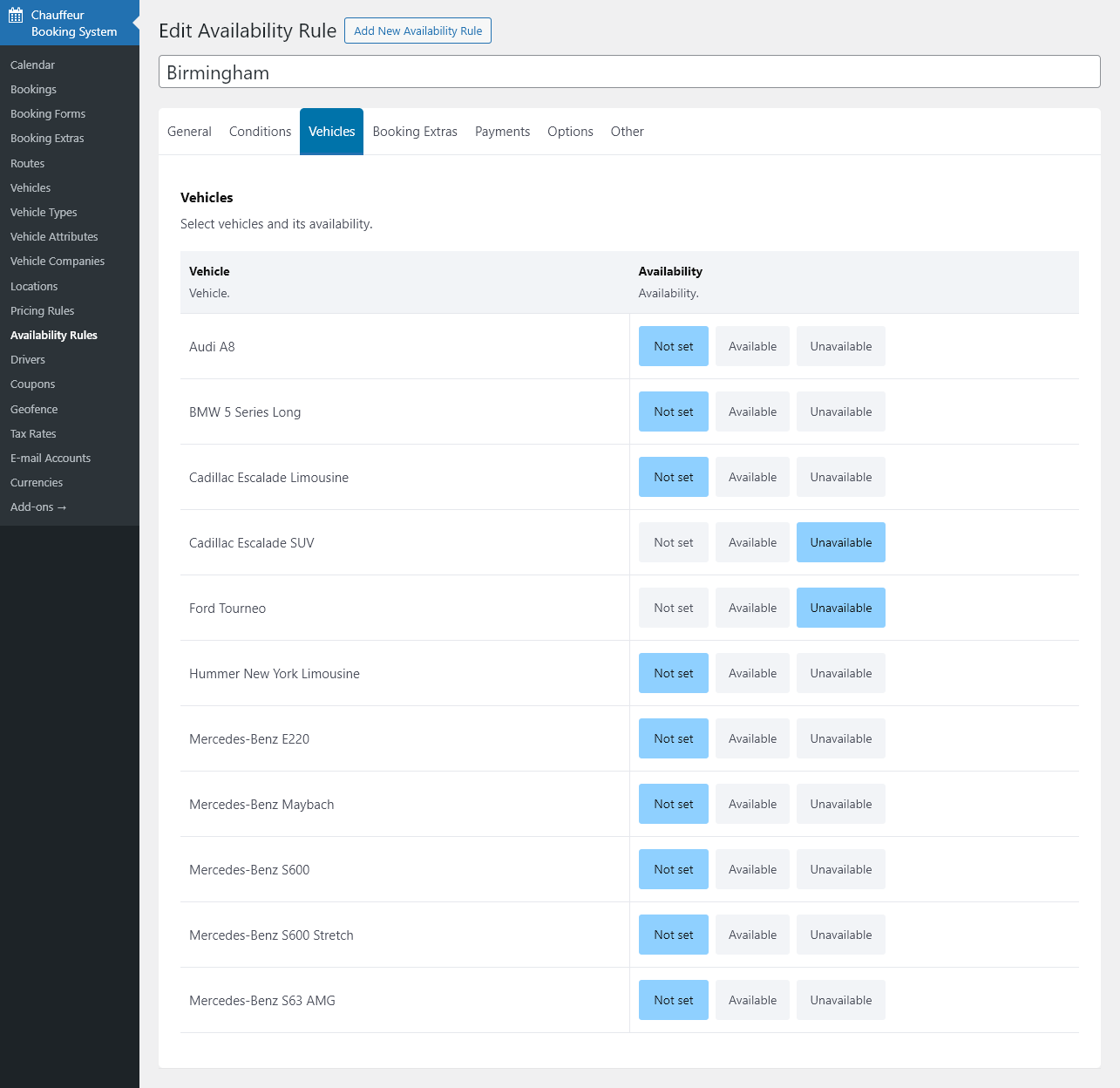
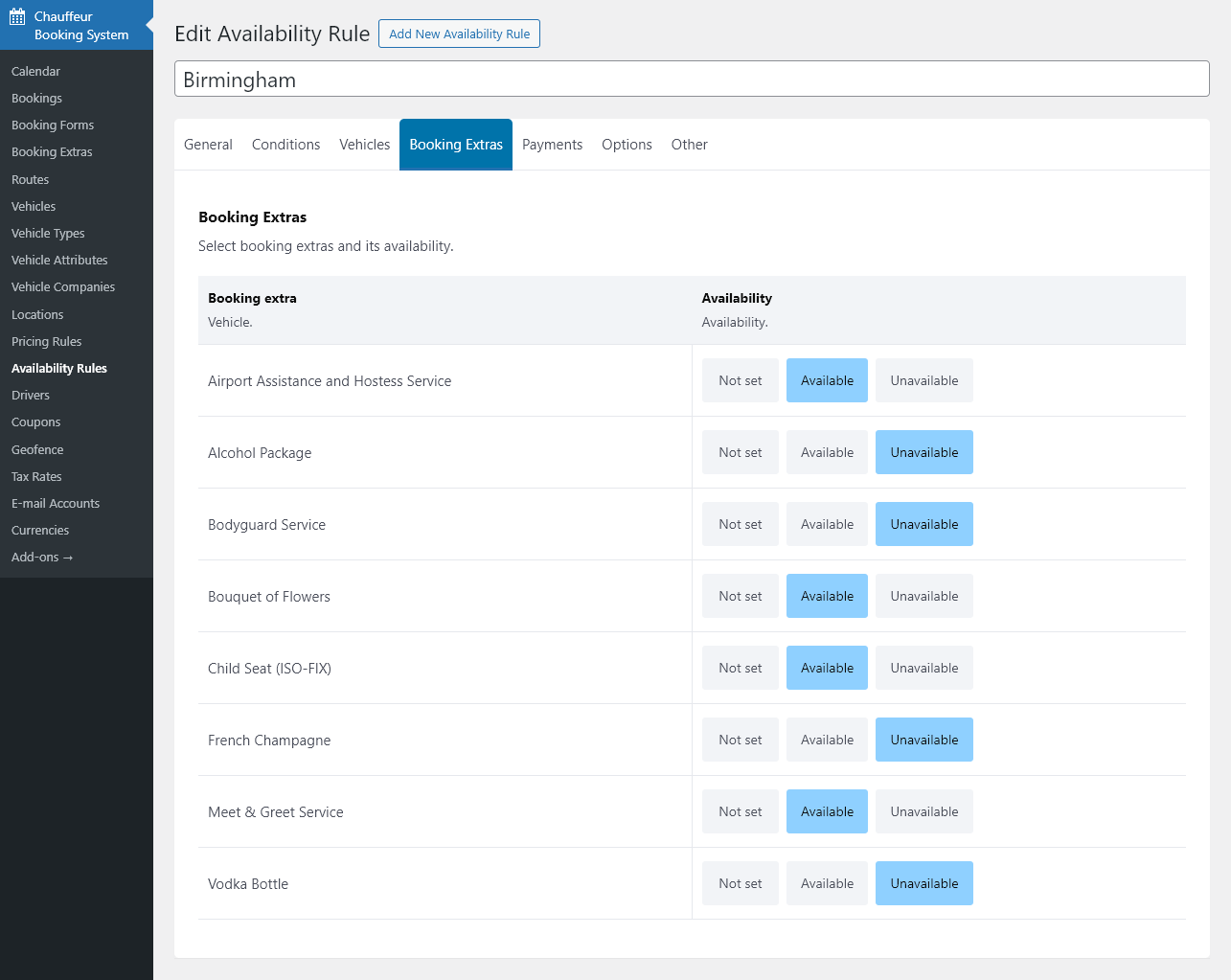
Availability rules define when services can be booked, which vehicles are eligible, and under what conditions a booking is considered valid. This logic is applied before pricing is finalized, ensuring that customers can only proceed with bookings that make sense operationally.
Different transport services require different availability rules. Hourly chauffeur services may depend on vehicle schedules and minimum rental times, while airport transfers often rely on predefined time windows or route-based availability. The system allows each booking model to follow its own availability logic without affecting others. This prevents common issues where a rule created for one service unintentionally blocks or alters another.
Availability is not limited to dates and times. Vehicle selection, capacity, service duration, and business hours all play a role in determining whether a booking can be accepted. The system evaluates these constraints together, reducing the risk of double bookings or impossible schedules. This is particularly important for chauffeur and limo services where vehicles are premium resources and availability must reflect real operational limits.
Despite the complexity behind the scenes, the customer-facing booking flow remains consistent across all service types. Users move through the same logical steps regardless of whether they are booking an airport transfer, an hourly service, or a fixed route. This consistency improves user experience while allowing businesses to offer a wide range of services without confusing customers or maintaining separate booking forms.
By combining structured availability logic with a unified booking flow, the system ensures that every confirmed booking is both valid and operationally feasible — a critical difference compared to simpler taxi plugins.
A transport booking system does not end with price calculation and availability checks. Payments, confirmations, and automated communication are critical parts of the booking experience — both for customers and for operators. The plugin treats these elements as integral components of the workflow, not optional add-ons.
Different transport businesses require different payment strategies. Some accept full prepayment, others prefer deposits, and some handle payments offline. The system supports multiple payment approaches and can adapt them to specific services or booking scenarios, allowing businesses to balance convenience, risk, and operational preferences.
Payment handling is designed to integrate naturally with the booking flow, ensuring that only valid and available bookings reach the payment stage.
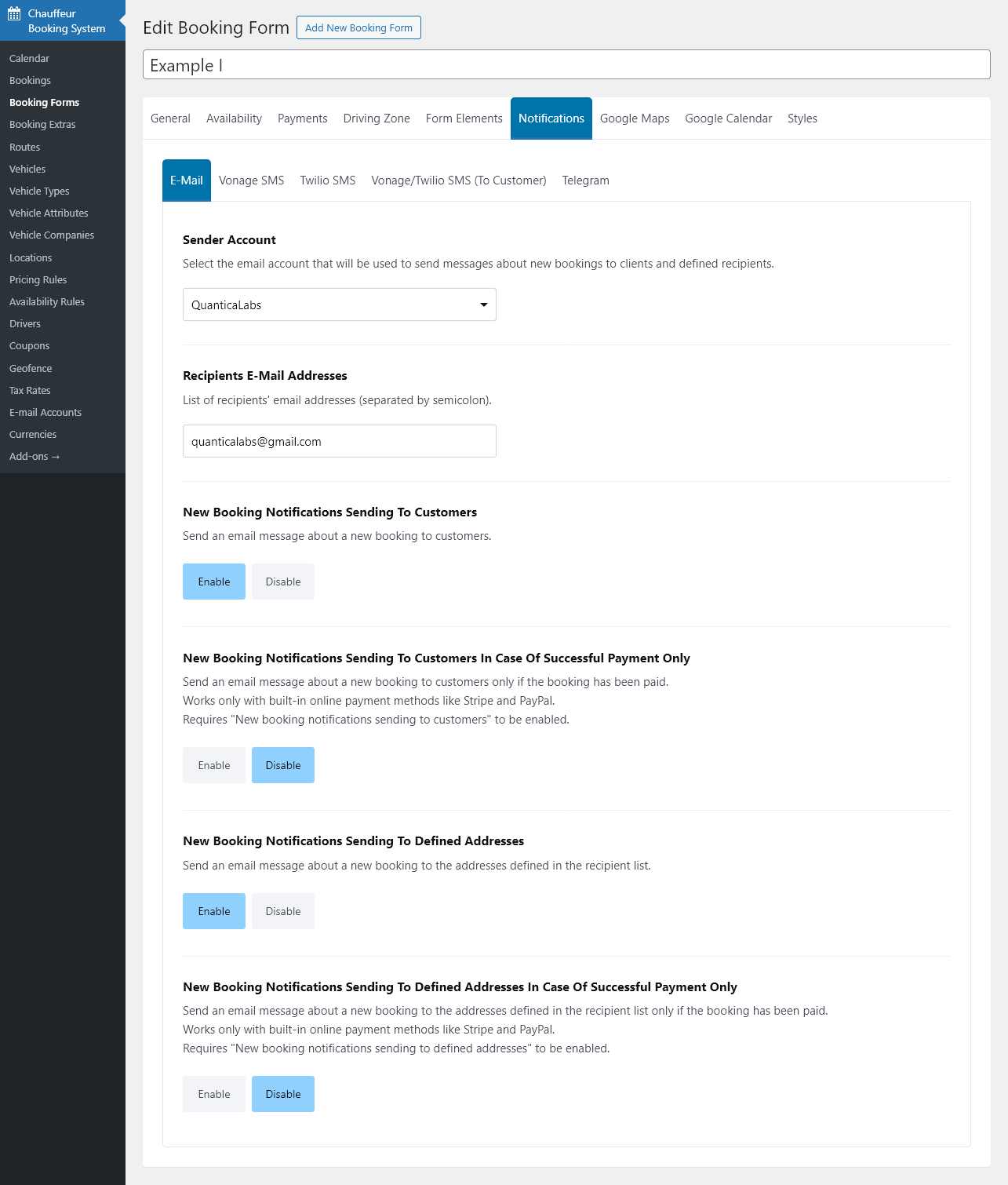
Clear communication is essential in transport services. Customers expect immediate confirmation, reminders, and accurate booking details. At the same time, operators need timely notifications to manage schedules and resources efficiently.
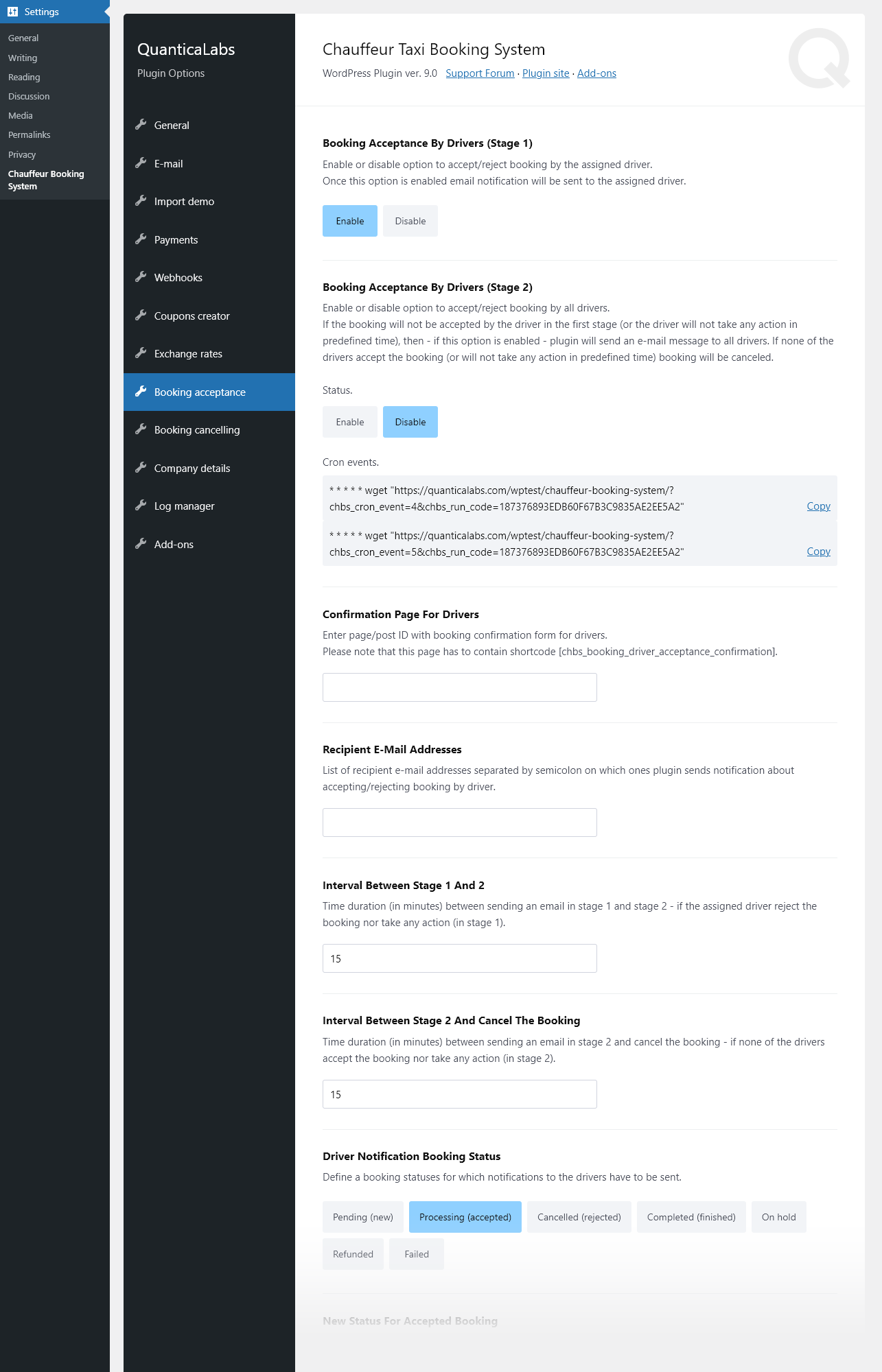
The system automates key communication steps, reducing manual work while keeping both sides informed throughout the booking lifecycle. Notifications are triggered by booking events rather than manual actions, helping businesses scale without increasing administrative overhead.
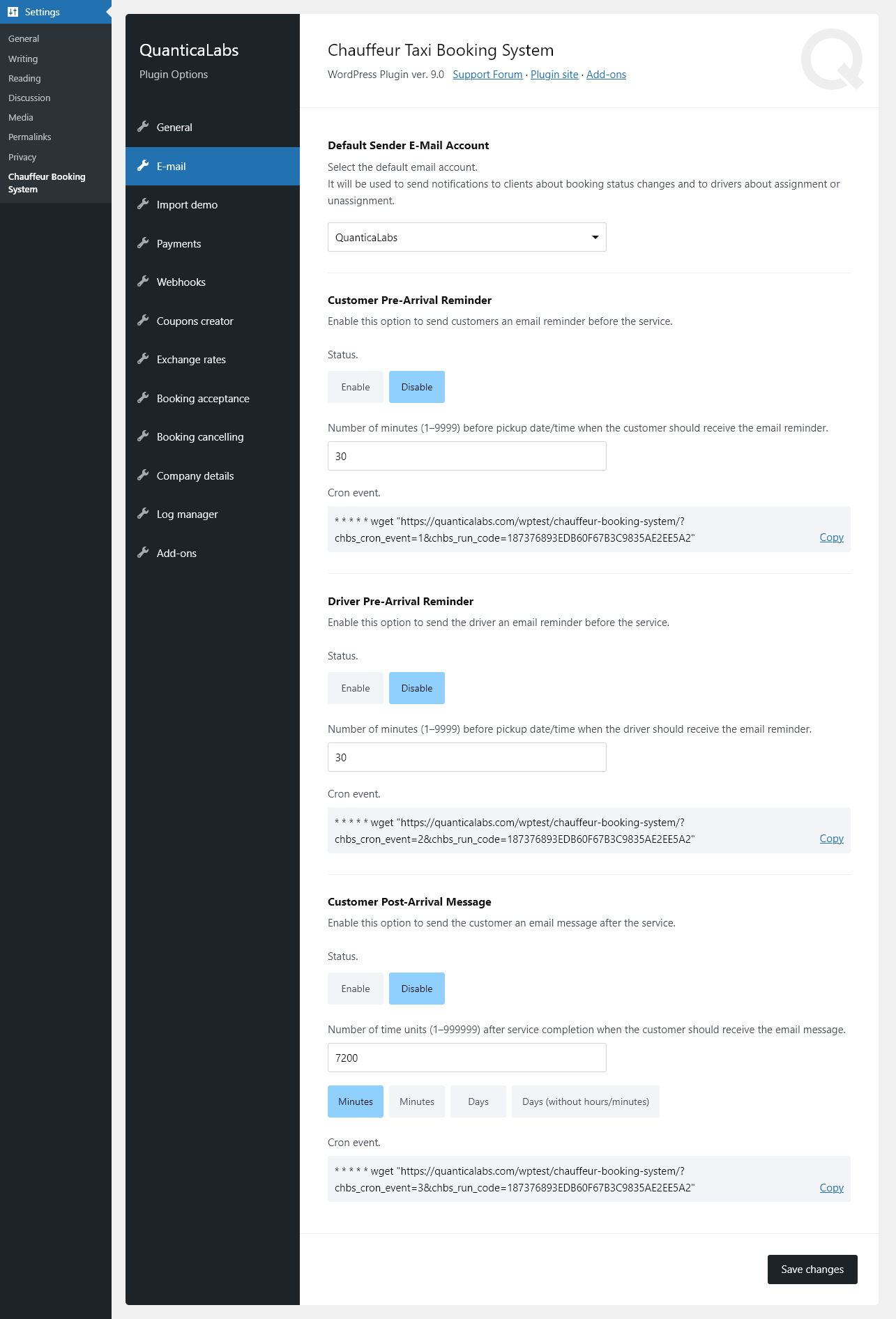
Beyond basic confirmations, the system supports event-driven messaging that can be scheduled around the ride itself. This ensures that communication happens at the right moment, before and after the service is completed.
Transport businesses often rely on external tools for accounting, calendars, marketing, or reporting. The Chauffeur Booking System is built to integrate with external services in a way that complements existing workflows instead of replacing them.
Integrations are designed to extend the system’s capabilities while keeping the core booking logic centralized. This allows businesses to connect payments, calendars, analytics, or communication tools without fragmenting their booking process.
By combining payments, notifications, and integrations into a single, coherent workflow, the system ensures that bookings move smoothly from reservation to execution — without manual intervention or disconnected tools.
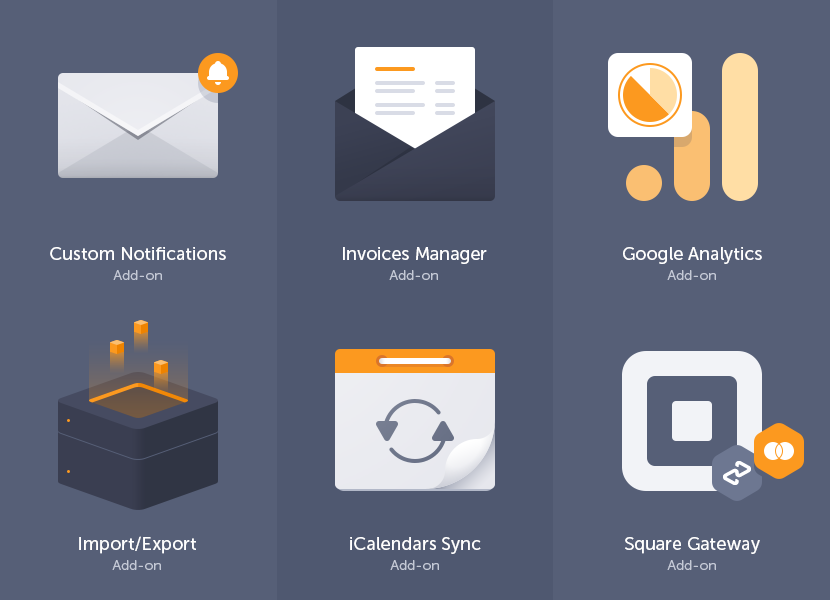
As transport businesses grow, their operational needs rarely stay the same. New payment methods, reporting requirements, marketing tools, or workflow automations often appear over time. This booking system was designed with this reality in mind, using an add-ons ecosystem instead of forcing every possible feature into the core plugin.
This approach keeps the main system focused, stable, and predictable, while allowing businesses to extend functionality only when it is actually needed. Rather than bloating the core with rarely used options, advanced capabilities are introduced as optional extensions that integrate directly into the existing booking workflow.
Add-ons are built to enhance specific areas of the system without changing its foundation. Payment integrations, external service connections, advanced notifications, reporting tools, and operational extensions can be added independently, allowing businesses to adapt the system to their workflow without restructuring their booking setup.
This modular design ensures that updates to the core plugin remain reliable and that additional functionality does not introduce unnecessary complexity for businesses that do not require it.
Importantly, businesses are not required to use add-ons from the start. The system is fully functional out of the box and can be expanded gradually as operational needs evolve.
This add-ons ecosystem makes the Chauffeur Booking System a long-term solution rather than a short-term tool — one that can grow alongside the business without forcing migrations to new platforms or booking systems.
The Chauffeur Taxi Booking System for WordPress is not designed to be everything for everyone. It is built for transport businesses that need control, flexibility, and predictable booking logic — and that understand the difference between a simple booking form and a real operational system.
In short, this system is designed for businesses that view online booking as a core operational tool rather than a simple contact form. For those businesses, the plugin offers the flexibility and structure needed to support growth without sacrificing control.
The Chauffeur Booking System is not the result of a single release or a short-term product idea. It has been actively developed and refined for over eight years, shaped by real-world feedback from hundreds of customers who run chauffeur, limo, and transport businesses on a daily basis.
Many of the system’s core decisions, from booking models and pricing logic to availability handling, notifications, and integrations, exist because customers needed solutions for real operational problems, not theoretical use cases. This continuous feedback loop has helped the plugin evolve into a mature, reliable booking system rather than a collection of disconnected features.
The plugin is also backed by a strong track record on the WordPress marketplace, supported by a high average rating and a large number of user reviews. This level of long-term feedback is difficult to achieve without consistent updates, active support, and proven usability in real business environments.
If you are looking for a transport booking solution that reflects how professional chauffeur and transport businesses actually operate — and that continues to improve based on real customer experience — the Chauffeur Taxi Booking System for WordPress is built with that long-term perspective in mind.
The Chauffeur Taxi Booking System for WordPress is built for businesses that need more than a simple fare calculator. With flexible booking models, rule-based pricing, and a mature add-ons ecosystem, it provides everything needed to run and scale a professional transport service.