- 23 March 2026
- updated 6 July 2026
- in WordPress Plugins
- 2744
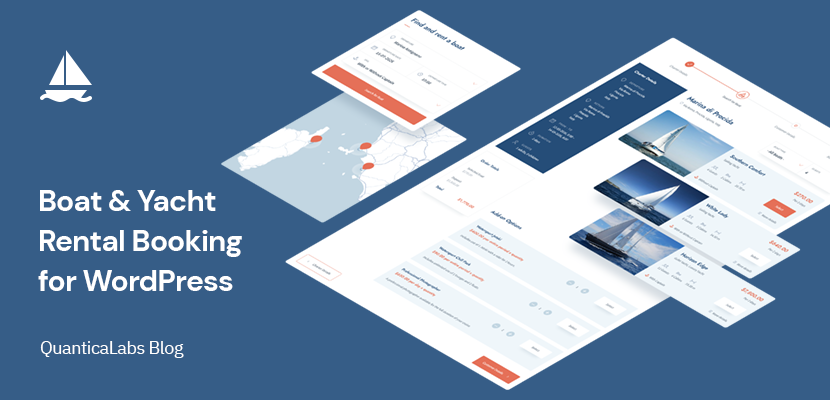
Imagine a customer trying to book a boat for the weekend. They check availability, ask about pricing, maybe request a skipper, and wait for confirmation. Now multiply that by several inquiries per day, across different boats, dates, and locations. Without a proper system in place, things quickly become messy.
This is where WordPress can become more than just a marketing website. With the right setup, it can work as a complete booking platform for boat rentals, yacht charters, and predefined cruise or tour packages. Instead of handling reservations through phone calls or email threads, you can manage the full workflow directly from your website.
In this article, I want to show what a modern boat rental website should actually include, what challenges usually appear in real-world booking scenarios, and how a dedicated WordPress plugin can help turn a standard website into a complete rental and charter system.
At first glance, a boat rental website may seem simple. Let the customer choose a date, select a location, and pick a boat. In reality, once you start accepting real bookings, the requirements become much more complex.
In practice, you need to handle availability across multiple boats and locations, often with different business hours, booking rules, and seasonal constraints. It also needs to support flexible pricing models, for example hourly or daily rentals, additional fees, or price changes depending on the number of guests.
Another important aspect is the booking flow itself. Customers expect a clear, step-by-step process where they first define their trip, and only then see matching boats or available charter packages. This approach reduces confusion and helps avoid invalid or unavailable selections.
Without a dedicated system, these elements are usually handled manually or through a mix of tools, which increases the risk of errors, double bookings, and missed opportunities.
This type of setup is not just theoretical. It is exactly how the Boat & Yacht Rental Booking System for WordPress is designed to work in real-world scenarios.
Not all boat rental businesses operate in the same way. Some focus on classic rentals, where the customer chooses a boat and books it for a specific period. Others offer predefined experiences, such as sunset cruises, guided tours, or event-based charters. In practice, many businesses need to support both models at the same time.
This is where many booking systems fall short. They are usually designed for either simple rentals or fixed packages, but not both. As a result, businesses are forced to use workarounds or separate tools. A more flexible approach is to support two booking modes within a single system.
This model is based on selecting a date, optionally choosing a time, defining a departure marina, and then selecting a boat that matches the criteria. It works well for standard rentals where the customer has full control over the schedule.
In this model, the customer selects a predefined offer, for example a sunset cruise or a half-day tour. Each package can define its own duration, schedule, and availability rules, which simplifies the booking process for structured experiences.
Supporting both approaches in one system gives much more flexibility. It allows businesses to offer standard rentals and curated experiences without changing their workflow or maintaining separate booking solutions.
You can see how both booking models work together in the Boat & Yacht Rental Booking System for WordPress.
A well-designed booking system should guide the customer step by step, without overwhelming them with too many options at once. Instead of browsing long lists, the user defines their trip first and then sees only relevant results.
A typical booking flow can look like this:
The booking process typically begins with defining the key details of the trip. This includes selecting the date and, if applicable, the time, as well as choosing the departure location and, in some cases, a different return point. Additional factors such as the number of passengers or whether a captain is required may also be part of this step, depending on how the offer is structured.
This stage establishes the full context of the booking and ensures that only relevant and available options are presented in the next steps.
Once the key criteria are defined, the system should present only the boats or offers that match the selected conditions. This helps avoid situations where unavailable or incompatible options are shown to the customer. At this stage, additional services such as a skipper, equipment, or other extras can be included, depending on how the offer is structured. The pricing should update accordingly as different options are selected.
In this step, the booking process typically requires collecting personal and billing details. Depending on the setup, additional fields may be included to capture information specific to the service or booking requirements. A payment method is also selected at this stage, allowing the booking to proceed to confirmation.
The final step provides a complete summary of the booking, including trip details, selected boat, extras, pricing, and customer information. It also includes elements such as coupon codes or required agreements, which need to be reviewed before completing the reservation.
This structured approach keeps the process clear for the customer and gives the business full control over how bookings are created and validated.
As soon as a business operates in more than one location or manages multiple boats, things can quickly become difficult to control. Availability, working hours, booking limits, and pricing rules may differ depending on the marina, the boat, or even specific dates.
A structured system should allow you to manage all of these elements independently, while still keeping them connected within a single booking workflow.
Each marina can operate with its own configuration. This may include business hours, excluded dates, advance booking limits, and different booking rules depending on the season. A well-designed system should also allow control over time gaps between bookings, support after-hours pickup and return, and define which types of bookings are available at a given location.
This level of control is especially important for businesses operating in multiple locations or offering different services depending on the marina.
Boats can be assigned to one or multiple marinas, which makes it possible to reuse the same fleet across different locations. Each boat can have its own configuration, including capacity, attributes, availability, and pricing.
What if you have several identical boats? Listing each one separately in the booking system is often unnecessary and makes availability management more difficult. A more practical approach is to present a single boat and handle availability by grouping all units of the same type.
Additional options, such as defining whether a boat is available with or without a captain, provide even more flexibility in how the offer is structured.
Together, these elements create a system where availability is not just a simple calendar, but a combination of location rules, fleet configuration, and booking conditions.
Pricing in a boat rental business is rarely simple. In practice, the final cost often depends on multiple factors such as location, duration, number of guests, or additional services.
A flexible pricing system should allow you to combine different pricing elements and adjust them based on specific conditions, without relying on manual calculations.
At the most basic level, pricing typically includes standard components such as a price per hour or day, initial fees, deposits, or additional charges for one-way charters and after-hours usage. Pricing per guest is also often used, especially for tours and shared charters.
In more complex scenarios, pricing needs to adapt to different conditions. For example, the final cost may depend on the selected marina, boat, booking duration, date range, day of the week, or number of passengers. It is also common to adjust prices during peak season, offer discounts for longer bookings, or apply different rates depending on the location.
A well-designed system should allow you to define these variations and combine them in a structured way, without relying on manual calculations or custom-built solutions.
This level of flexibility is built directly into the Boat & Yacht Rental plugin, allowing you to configure complex pricing scenarios without additional work.
Beyond availability and pricing, a booking system also needs to handle additional services, payments, and external integrations. These elements often make the difference between a basic setup and a fully operational booking platform.
Optional extras such as a skipper, equipment, or additional services are a common part of boat rental offers. Each extra can follow a different pricing model, for example per booking or per day, and may vary depending on the selected boat or marina.
In practice, boat rental businesses often need to support multiple payment methods, including both online and offline options. This may include payments via services such as PayPal or Stripe, as well as cash or wire transfers. In some cases, integrating with tools like WooCommerce can help extend payment options and manage orders within a familiar environment.
Additional integrations help connect a booking system with external tools and services. Google Maps can support location selection and address autocomplete, while Google Calendar integration makes it possible to synchronize bookings.
Notifications are typically handled through email, SMS, or messaging platforms, ensuring that both the business and the customer stay informed about new bookings and updates.
This is exactly the type of setup implemented in the Boat & Yacht Rental Booking System for WordPress, which combines all of these elements into a single, cohesive booking solution.
As you can see, building a booking system for a boat rental business is not a simple task. It involves many interconnected elements, from availability and pricing to fleet management, locations, and customer communication. Trying to handle all of this with generic tools or manual processes quickly becomes inefficient and difficult to scale.
This is why a more structured approach is needed. Instead of combining multiple tools or building everything from scratch, it makes more sense to use a dedicated system that brings all of these elements together in one place.
Boat & Yacht Rental Booking System for WordPress is designed for businesses that need a reliable and scalable way to manage bookings directly on their WordPress website. It works well for both simple setups and more complex operations.
If you are looking for a system that goes beyond a basic booking form and reflects how real rental businesses operate, this approach gives you the flexibility and control needed to manage everything in one place.
The Boat & Yacht Rental Booking System for WordPress is designed for businesses that need more than a simple booking form. With support for rentals and charter packages, flexible pricing rules, and full control over marinas and fleet, it provides everything needed to run and scale a professional boat rental operation.

We create WordPress plugins and themes used by businesses around the world. With more than 15 years of experience and over 125,000 products sold, we focus on building reliable tools that simplify bookings, rentals, scheduling, and online services.


